- 1With the final completion of the 36-month FlareDrops in January 2026, Flare fully transitioned from token distribution to utility-driven tokenomics. FIP.16 lowered the annual inflation target to 3% (capped at 3B FLR/year).
- 2By increasing EIP-1559 base gas fees by 20x, transaction burn rates accelerated 20-fold. In parallel, the newly established FIRE entity aggregates 100% of FAssets mint fees and ~90% of FDC fees to execute market buybacks and permanent burns.
- 3As ecosystem TVL and transaction volumes expand, Flare approaches the tipping point where daily burns exceed new issuance, creating net deflation.
1. Why FIP.16? Taming Inflation in the Post-FlareDrop Era
Flare's initial tokenomics revolved around FlareDrops—a 36-month distribution of 24.25B FLR to Wrapped FLR (WFLR) holders that drove high ecosystem participation but was coupled with a 5% (~5B FLR/year) inflation cap.
On January 30, 2026, the 36th and final FlareDrop completed successfully. With dilution pressures ended, the community approved FIP.16 with a 98.06% supermajority, shifting Flare toward a utility-driven deflationary model.
Legacy Design (Before) vs. FIP.16 & FIRE Design (After)
Token value depends on the balance between new supply entering from the faucet and tokens permanently removed through the drain.
Wide-Open Faucet × Tiny Drain (High Inflation)
Large amounts of new FLR were minted every year to fund rewards, creating structural dilution.
Because minimum fees were extremely low, high transaction volume burned very little FLR.
Even as DeFi grew, there was no mechanism to replace inflationary issuance with real revenue.
40% Narrower Faucet × Dual Burn Engines
Lowering annual inflation from 5% to 3% immediately slows down new token dilution.
Fees remain fractions of a cent for users, while automated oracle & DeFi txs burn 20x more FLR.
Like corporate share buybacks, partner protocol fees buy back, burn, or fund rewards without minting.
Key FIP.16 Metrics
Annual inflation cap reduced from 5% (5B FLR) to 3% (3B FLR), eliminating 2B FLR in annual issuance while supercharging burning mechanisms.
2. The Dual-Engine Burn: 20x Gas Burn and Protocol Entity 'FIRE'
FIP.16 pairs direct transaction fee destruction with protocol revenue buybacks.
First, base gas fees across the Flare C-Chain EVM were scaled 20x (25 gwei to 500 gwei). Every smart contract execution permanently burns 100% of its base fee.
Second, the Flare Income Reinvestment Entity (FIRE) pools real protocol revenues—including 100% of FAssets mint fees and ~90% of FDC attestation fees—to buy back and burn FLR on the open market, or fund validator incentives in place of new inflation.
Dual-Engine Burning Architecture under FIP.16
Direct gas burn scaling alongside protocol revenue aggregation via the FIRE entity
STEP 1: On-Chain Demand
XRPFi transactions, FAssets minting, and FDC attestation requests generate on-chain activity.
STEP 2: Dual-Stream Processing
Base gas fees (500 gwei) are 100% burned immediately; mint and attestation fees route to FIRE.
STEP 3: Deflationary Tipping Point
FIRE executes open-market buybacks and burns, driving net supply downward towards deflation.
Inflation Target Reduced
Capped at 3% (~3B FLR/year), down from 5% (~5B FLR), eliminating 2B FLR in annual dilution.
Base Gas Multiplier
Increased 20x from 25 gwei to 500 gwei, amplifying transaction-driven deflation.
Protocol Revenue Capture
100% of FAssets mint fees and ~90% of FDC verification fees redirected to ecosystem value accretion.
3. The Deflationary Tipping Point: Balancing Issuance and Burns
With daily issuance constrained to roughly 8.22M FLR, sustained network activity across XRPFi, FDC attestations, and oracle updates brings Flare closer to becoming net-deflationary.
Track on-chain burn metrics and inflation offset percentages live on our /token and /now pages.
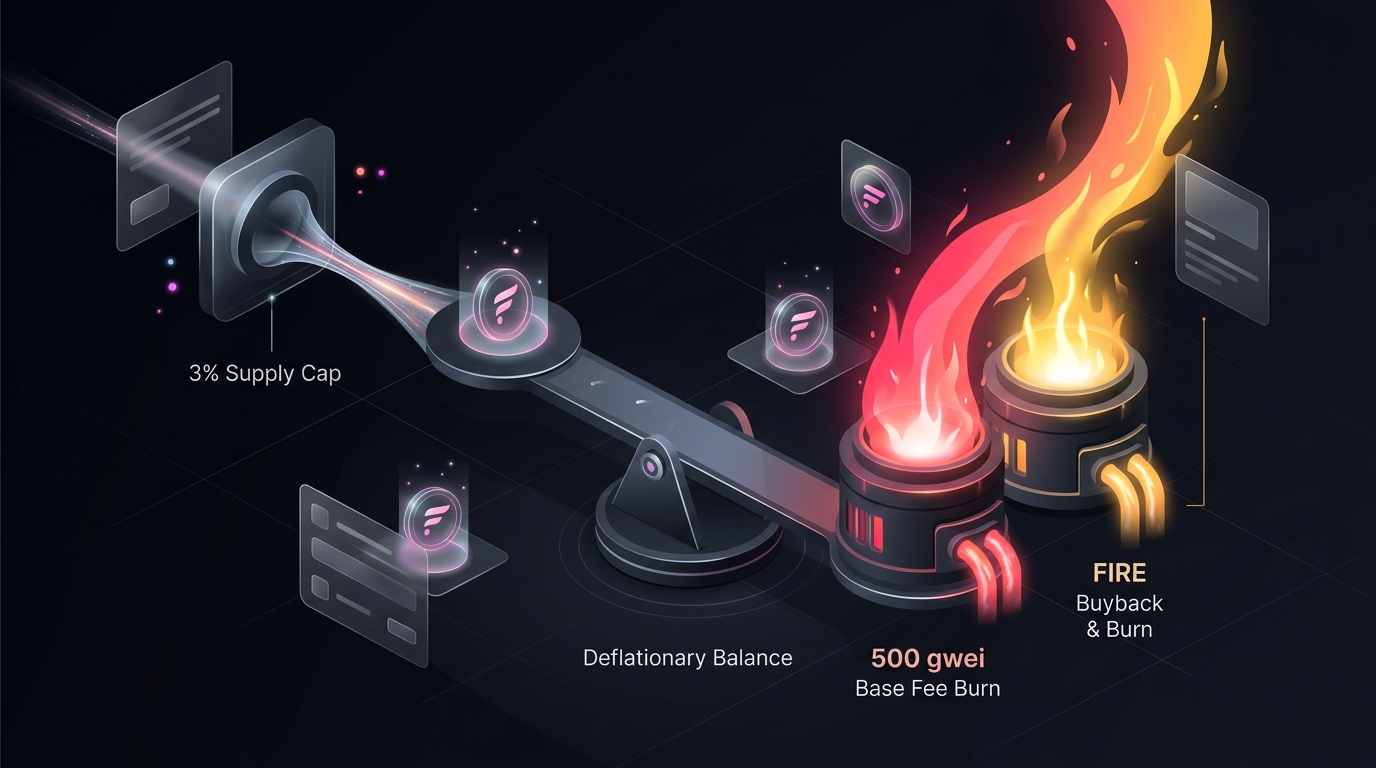
The Deflationary Scale: Offsetting ~8.22M FLR/Day
Under the 3% cap (~8.22M FLR/day), two burn and absorption engines sit on the opposite side of the scale.
~8.22M FLR / day
Daily equivalent of the 3% annual cap (~3B FLR/yr)
Distributed as FTSO delegation and P-Chain validator staking rewards
Engine 1: Automated Base Fee Burn (500 gwei)
Permanently destroys FLR 24/7 on every FTSO 1.8s update, FDC proof, and DeFi tx
Engine 2: FIRE Protocol Revenue Recycling
Uses XRPFi & DeFi protocol revenue to buy back/burn FLR or fund rewards without minting
3 Key Metrics Users Should Watch on /now and /token
1. Daily Burn Velocity
How steeply cumulative burned FLR climbs under the 500 gwei floor
2. FXRP Minted & Ecosystem TVL
The revenue-generating scale of XRPFi & DeFi protocols feeding FIRE
3. Net Effective Inflation
Whether (New Issuance − [Fee Burn + FIRE Absorption]) approaches zero or below
4. What FLR Holders Should Know
Holders maximize value by participating: wrapping to WFLR for FTSO delegation or locking FLR in P-Chain staking (which received 5x consensus weight under FIP.16).
Key indicators to watch include daily FLR burn volume, FIRE cumulative revenue, and total P-Chain staked volume.
Related Glossary Terms
Explore glossary definitions for key concepts mentioned in this article.
Primary Sources & Official References
This analysis is substantiated by the following verified announcements, presentations, and coverage.
- 2026-04-12