- 1In October 2026, Doppler Finance announced a strategic partnership with Flare Network at XRP SEOUL 2026, followed immediately by Flare's official announcement that Firelight Protocol has gone live.
- 2Firelight expanded its aggregate staking deposit cap to 115 million XRP. Depositors receive stXRP for DeFi yield and composability, while their staked capital acts as a collective backstop underwriting DeFi Loss Coverage for protected vaults (starting with Sentora).
- 3Far from being just 'for XRP holders', the updated tokenomics under Core Vault and FIP.16 directly tie XRP activity to FLR value via a 20x higher gas burn rate, protocol revenue redirection to FIRE (inflation reduction & buybacks), and redemption fee sharing.
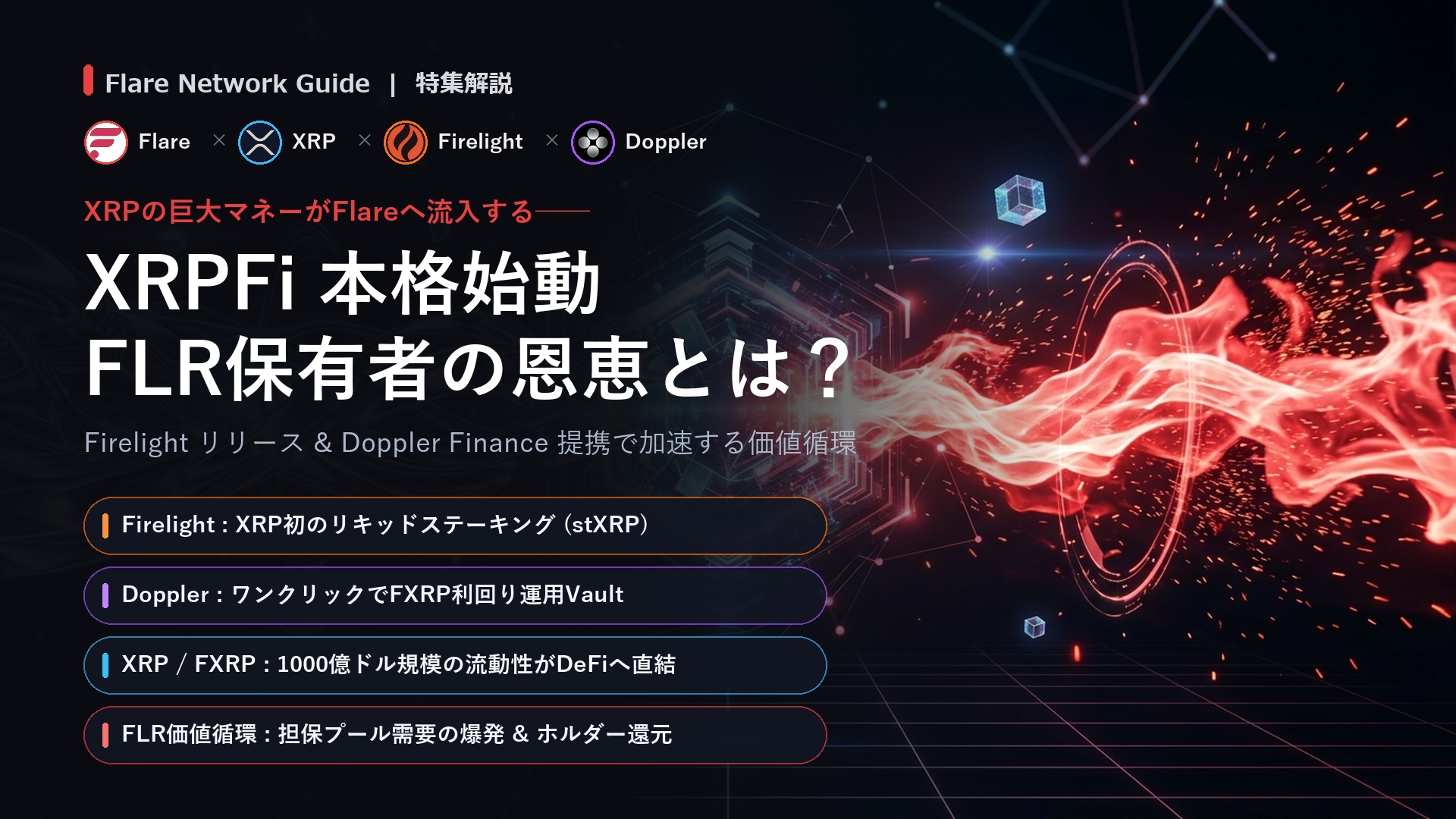
1. What Happened? Announcement Context and Verified Sources
On October 3, 2026, during the XRP SEOUL 2026 conference in South Korea, structured yield platform Doppler Finance officially announced a strategic partnership with Flare Network.
The core objective is to give XRP holders direct, frictionless access to Flare's FXRP vaults directly from the Doppler platform, turning passive XRP into active 'working capital.'
Shortly following this on October 6, 2026, Flare officially announced that Firelight Protocol is live. Backed by an $8M seed round led by gumi Cryptos Capital, Firelight expanded its aggregate staking deposit cap to 115 million XRP, launching its first on-chain loss coverage for Sentora's USD Protected Vault and Protected RWA Vaults.
Furthermore, via Flare Smart Accounts (FSA), XRP holders can now bridge and stake into Firelight in a single XRPL wallet transaction—minting FXRP and receiving stXRP seamlessly.
This marks the critical transition where FAssets infrastructure connects directly to user-facing yield destinations.
How XRP Activity Directly Accrues Value to FLR
XRP yield destinations and FLR token scarcity operate within a single closed-loop economic engine.
XRP Inflow & Yield
Transforming idle XRP
- Automated yield via Doppler
- stXRP (LST) liquid staking via Firelight
Core Vault & Efficiency
Free from Collateral Bottlenecks
- Direct Core Vault deposit unlocks seamless inflow
- Mint fees to FIRE, redemption fees to pool
Burns & FIRE Accrual
Organic Value Accrual
- 20x higher base fee burns FLR on every action
- FIRE captures fees to curb inflation & buy back FLR
Primary Source Highlights
Doppler announced direct institutional vault routing from XRPL wallets, while Firelight launched live with a 115M XRP deposit cap, enabling stXRP yield while underwriting shared protection across DeFi vaults.
2. Doppler Finance vs Firelight Finance: How They Differ
Rather than competing, Doppler and Firelight serve complementary roles within Flare's XRPFi architecture: Doppler acts as the 'yield execution engine', while Firelight serves as the 'security and staking foundation.'
Doppler channels massive XRPL liquidity into Flare's automated vaults, while Firelight pools staked FXRP to underwrite protocol-level loss coverage for participating DeFi vaults.
Crucially, the roles are distinct: Firelight stakers receive stXRP (an LST) to earn streaming yield and maintain DeFi composability, in exchange for providing underwriting capital. Meanwhile, coverage (loss compensation against exploits and oracle failures) protects the service-side DeFi vaults (such as Sentora) and their depositors. Stakers take on slashing risk as protocol security providers rather than having their own deposits insured.
Doppler Finance
Structured Yield Platform
Core Experience
One-click institutional yield strategies without manual bridging
Role in Flare
Inflow gateway funneling passive XRPL liquidity into FXRP Vaults
Firelight Finance
Liquid Staking & Shared Risk Cover
Core Experience
Stake FXRP for stXRP yield & DeFi composability, while pooled capital underwrites on-chain loss cover for protected vaults
Role in Flare
Shared protection layer underwriting vault risks across Flare DeFi
3. Crucial Analysis: Why Does This Matter to FLR Holders?
Under Flare's /fip#fip-16 and /tech#fassets economic frameworks, the success of XRPFi directly translates into tangible benefits for FLR holders through four distinct channels:
【Channel 1: Core Vault Capital Efficiency & Collateral Pool Role】
Earlier FAssets iterations required extensive FLR overcollateralization for every minted FXRP, creating capital bottlenecks. The introduction of the XRPL multi-sig 'Core Vault' (FAssets v1.3) allows direct deposit minting and removes dependence on agent capital lockups. While FXRP growth no longer mechanically locks up massive amounts of circulating FLR, collateral pools remain vital for redemption backstops: under FIP.16, the vast majority (~90%) of redemption fees are distributed directly to collateral pool participants and agents.
【Channel 2: 100% Gas Fee Burns (20x Base Gas Multiplier)】
All automated vault rebalances, yield compounds, and insurance actions execute on the Flare EVM and burn 100% of consumed FLR gas fees. Following FIP.16's 20x base fee increase (25 gwei to 500 gwei), XRPFi on-chain volume exerts significantly stronger deflationary pressure on FLR supply.
【Channel 3: Protocol Revenue Redirection via FIRE】
Recognizing that Core Vault reduced FLR's collateral footprint, FIP.16 established the 'Flare Income Reinvestment Entity' (FIRE). 100% of FAssets mint fees and ~90% of FDC attestation fees are funneled into FIRE. FIRE utilizes these organic earnings to replace inflation-based staking emissions (driving gross inflation below 3%) and conduct open-market FLR buybacks and ecosystem support.
【Channel 4: FTSO Utility & Delegation Rewards】
High-frequency DeFi strategies and liquidations rely on Flare's enshrined FTSO v2 feeds, reinforcing data provider revenue and rewarding WFLR delegators.
Economic Feedback Loop
Core Vault removes capital friction for XRP inflow → Active XRPFi accelerates 20x boosted EVM gas burns → Protocol fees accumulate in FIRE to suppress inflation and buy back FLR.
4. Practical Outlook and Risk Disclaimer
Integrations are rolling out progressively. Users and holders should maintain a measured approach: observe on-chain TVL trends live on our /now dashboard, understand smart contract risks, and align strategies with personal risk tolerances.
Quick Decision Guide: What Should You Do?
Recommended strategies based on your current holdings and risk appetite.
FLR-Only Holders
No rush to enter DeFi. Maintain your WFLR delegation or staking rewards while directly benefiting from 20x higher gas fee burns and FIRE inflation reduction.
Idle XRP Holders
Prime beneficiary. Monitor the Doppler Vault release and Firelight caps, and test small allocations for productive working yield.
Cautious / Observers
A perfectly valid approach. Monitor smart contract audits and TVL trends on the Flare Explorer before taking active steps.
Disclaimer
This content is strictly for educational purposes and does not constitute financial or investment advice. Exercise caution and assess your own risk tolerance.
Related Glossary Terms
Explore glossary definitions for key concepts mentioned in this article.
Primary Sources & Official References
This analysis is substantiated by the following verified announcements, presentations, and coverage.
- 2026-10-03
- media24/7 Wall St: XRP Drops 51% in a Year Despite New Ways to Earn Yield (Doppler & Flare Coverage)2026-10-04
- 2026-09-24
- 2026-10-06
- 2026-10-06
- 2026-10-03
- 2026-09-15
- 2026-10-03